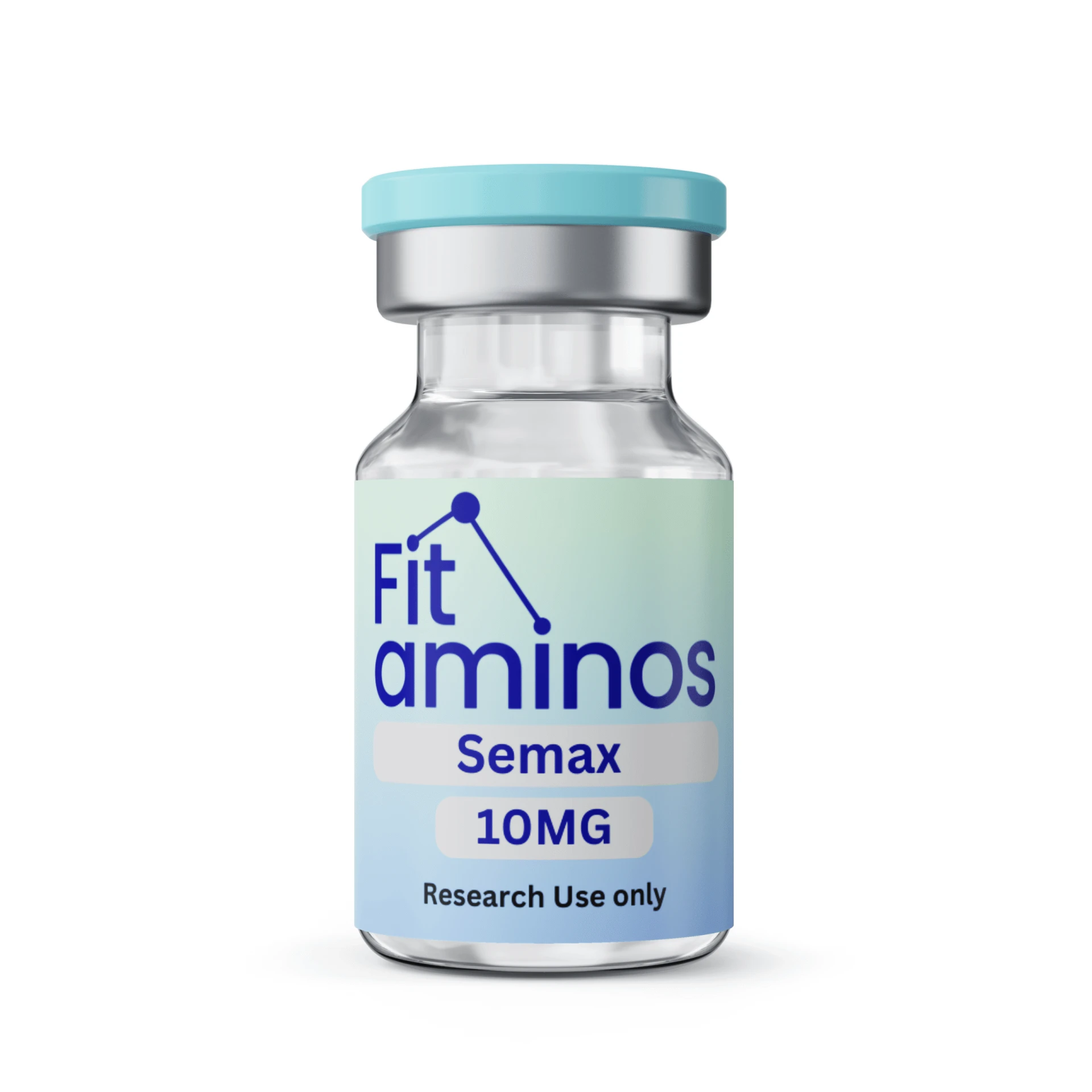
Semax is a seven residue synthetic peptide, sequence Met-Glu-His-Phe-Pro-Gly-Pro. CAS 80714-61-0, molecular formula C37H51N9O10S, molecular weight 813.9 g/mol. It ships as a lyophilized powder in a 10mg vial, listed in this catalog under the code SMX, for laboratory research use only.
This page covers the chemistry, the compound’s current standing with the FDA, and one thing about its documentation that we would rather tell you up front than have you find out after ordering.
What is Semax?
Semax is a hormone fragment with a stabilising tail attached.
Adrenocorticotropic hormone is 39 residues long. Residues four through seven are Met-Glu-His-Phe, a short run that has been studied on its own for decades and is usually written ACTH (4-7). Semax is that fragment with Pro-Gly-Pro added to the C terminus. Four residues plus three, giving seven.
The Pro-Gly-Pro tail, and why two different compounds here share it
Short peptides do not last long in solution. Peptidases cut them, and a four residue fragment has almost no structure to resist that.
Proline is the residue that changes the arithmetic. Its side chain bonds back onto its own backbone nitrogen, which rigidifies the local geometry and makes neighbouring bonds harder for an enzyme to align with and cleave. Ending a chain with a run containing two prolines is a cheap, effective guard.
Selank uses the identical tail on a completely different head, built from tuftsin rather than from ACTH. Both compounds came out of the Institute of Molecular Genetics at the Russian Academy of Sciences, and the shared ending is a design signature rather than a coincidence.
| Compound | First four residues | From | Tail | MW |
|---|---|---|---|---|
| Semax | Met-Glu-His-Phe | ACTH (4-7) | Pro-Gly-Pro | 813.9 |
| Selank | Thr-Lys-Pro-Arg | Tuftsin | Pro-Gly-Pro | 751.9 |
Semax is the heavier of the two, largely because it carries a methionine, which is where the sulfur atom in its formula comes from. It is the only sulfur containing compound of the pair.
Specification
| Compound | Semax |
| Catalog code | SMX |
| Sequence | Met-Glu-His-Phe-Pro-Gly-Pro (MEHFPGP) |
| Parent fragment | ACTH (4-7) |
| CAS number | 80714-61-0 |
| Molecular formula | C37H51N9O10S |
| Molecular weight | 813.9 g/mol |
| Residue count | 7 |
| Origin | Institute of Molecular Genetics, Russian Academy of Sciences |
| Vial size | 10mg |
| Storage | Keep lyophilized, cold, sealed and out of light until use |
| Classification | Research chemical. Not for human or veterinary use. |
The documentation gap, stated plainly
There are 70 lot certificates published across this catalog. None of them is a Semax lot.
Every other compound in this reference set has at least one published certificate. Tesamorelin has four. Semax has none.
This is a publishing gap rather than a testing gap. Material goes to the lab on the same policy as everything else. What is missing is the certificate on the site, and publishing certificates is the entire reason the library exists, so an unpublished one is a real gap and not a technicality.
So the practical advice, until it is up: ask for the certificate before you order rather than after. Email the lot number to support@fitaminos.com and ask for the report. That advice holds for any supplier in this category, including this one. A seller who cannot produce a certificate for a specific lot has told you something useful.
No Semax certificate yet
Ask for the report before you order.
Seventy lot certificates are published across this catalog and none of them is Semax. That is a real gap, so email the lot number and ask first.
What a Fit Aminos certificate contains, when there is one
Since there is no published Semax certificate to walk through, this section serves a different purpose than it would on the other pages. It is the list of what to ask for, and it applies to any supplier rather than only to this one.
Treat it as a checklist. A report that carries all five fields is a real document. A report that carries a purity percentage and nothing else is a screenshot of a number, and the number is unfalsifiable without the rest.
Purity by HPLC-UV at 214 nm
The sample is separated by high performance liquid chromatography and the detector reads absorbance at 214 nanometres, which is where the peptide bond itself absorbs rather than any particular side chain. That wavelength is chosen precisely because it responds to the backbone every peptide shares, so related impurities show up rather than hiding.
The target compound produces one peak, impurities produce their own, and purity is reported as the target’s share of the total area under all of them. Ask for the wavelength as well as the number. A purity figure quoted without its method is not comparable to one that has been.
The specification across this catalog is 98.0% or better, and published lots have run between 99.4% and 99.9%.
Identity by LC-MS
Observed mass against theoretical mass for the intended sequence. This is the test that catches a substituted or mislabelled compound. Purity tells you the material is clean, identity tells you it is the right material, and only the first is usually advertised.
Net peptide content
The measured mass of actual peptide in the vial, reported separately because lyophilized powder also contains counter ions and residual moisture. Purity is a ratio and cannot tell you quantity. Published lots in this catalog have run from 97% to 125% of their labelled mass, which is exactly why the figure is worth asking for.
Endotoxin by LAL against USP <85>
The Limulus Amebocyte Lysate assay detects bacterial endotoxin, the lipopolysaccharide left behind by gram negative bacteria. It is run in duplicate at a sensitivity of 0.05 endotoxin units per millilitre where it is performed at all.
Two things about the wording matter. Cleared means none was detected above the assay’s floor, which is a different statement from zero, and any certificate phrasing it as zero is claiming more than the method can deliver. And not every lot gets the assay run, so the honest certificate records that as not applicable rather than omitting the row and letting the absence pass unnoticed.
The accession number
The laboratory’s own internal record number for the tested unit. On published lots elsewhere in this catalog it looks like 2509240085 or 2603310202.
This is the field that makes every other field checkable, and it is the one almost nobody publishes. Without it, a certificate is a PDF hosted by the party selling you the product, and a PDF is trivially editable. With it, the result can be confirmed against the laboratory’s own record by someone who has no stake in the answer.
Ask for it by name. A supplier who will give you a purity number but not an accession number is offering you a claim rather than a verification.
Where Semax stands with US regulators
Two facts that are often conflated, so taken separately.
Semax is an approved medicine in Russia, where it was developed and where most of the clinical work was done.
Semax has no FDA approval in the United States, in any formulation, for any use. A foreign marketing authorisation is not a US approval and does not make a compound lawful to market here for human use.
In July 2026 the FDA’s Pharmacy Compounding Advisory Committee reviewed six peptide families for possible addition to the 503A Bulks List. Semax was one of the six, along with BPC-157, KPV, TB-500, MOTS-c and epitalon.
That recommendation is not an approval, it is not a ban, and it concerns pharmacy compounding rather than research supply. What it does indicate is that the agency is looking at this compound now, which is worth factoring in before building anything long term around it.
Why there is no effects section
Nothing here describes what Semax does in a person, and nothing describes how to use the vial.
An unapproved compound described by its seller in terms of its effect on a body is an unapproved drug in the FDA’s reading. The agency made that case to seven online peptide sellers in March 2026, and the research use only wording those sites carried protected none of them.
The published work is indexed on PubMed. A good deal of it is Russian language and a good deal is animal work, which is worth knowing before you read it as though it were something else.
Common questions
Why is there no certificate for Semax when there are 70 on the site?
Because the Semax lot certificates have not been published yet. It is a gap in the library rather than a gap in testing, and it is being flagged here rather than left for you to discover. Ask for the certificate by email and it will be sent.
Is Semax the same as Selank?
No. They share the Pro-Gly-Pro tail and the same institutional origin and they differ in the first four residues, which come from different parent molecules. Different sequences, different CAS numbers, different molecular weights.
Semax is approved in Russia. Does that count for anything here?
Not with the FDA. A Russian approval is a decision under Russian law by a Russian regulator, and it has no legal effect in the United States.
What does the July 2026 committee recommendation mean for buying it?
Directly, very little today. The recommendation concerns whether the compound may be used in pharmacy compounding, not whether it can be supplied for research. Indirectly it signals regulatory attention, so it is a reason to watch the category rather than assume the current position holds indefinitely.
Why does the catalog call it SMX?
Shorthand used across this category. It is the same compound.
Ask before you order
Given there is no published certificate for this compound yet, asking first is the right order of operations here.
Ask, then order
A supplier who cannot produce one has told you something.
That test applies to us as much as to anyone else in this category. Email the lot number and see what comes back.
Research use only. Not for human consumption. Not approved for medical, therapeutic, diagnostic, or veterinary use.