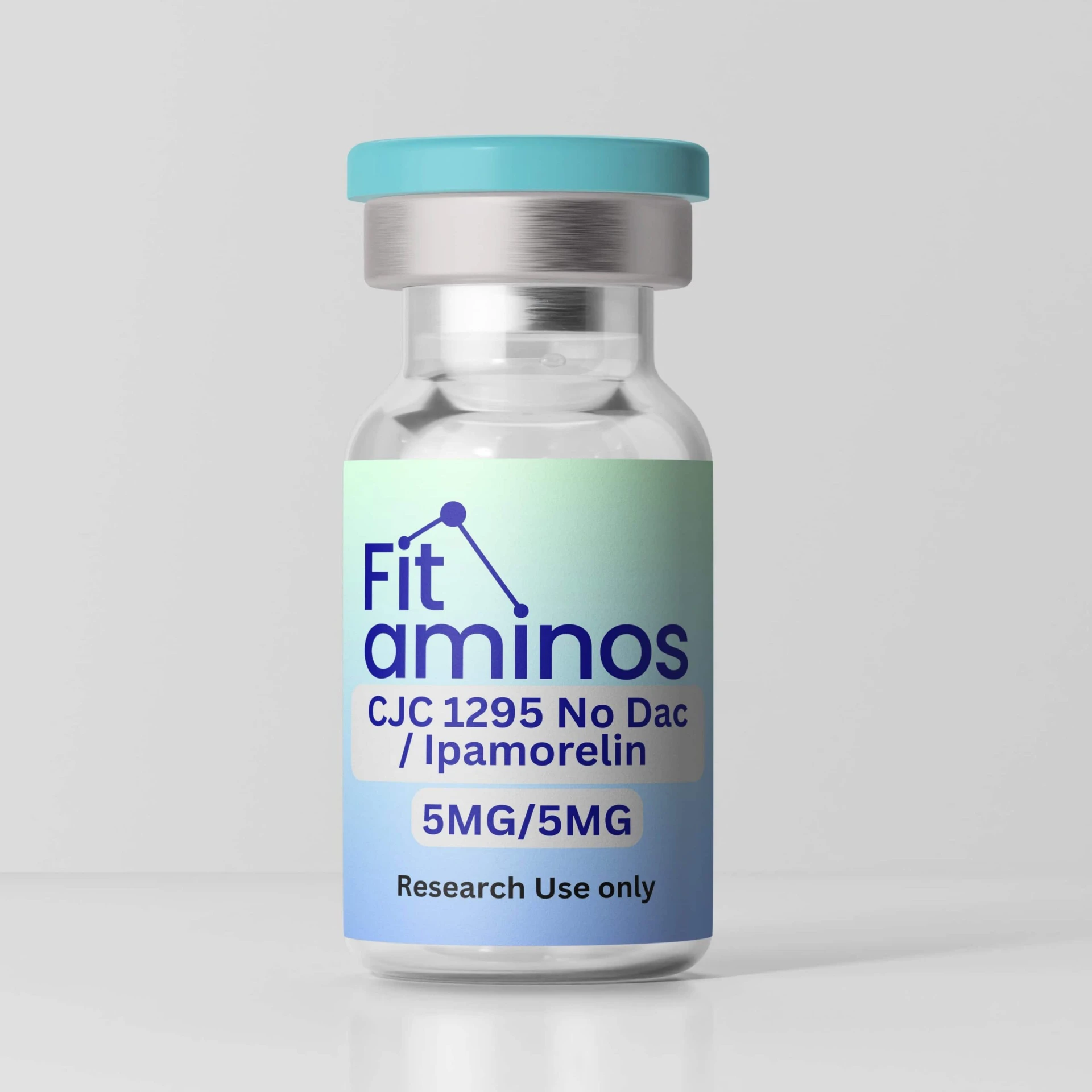
This is two different molecules in one vial: 5mg of CJC-1295 without DAC and 5mg of Ipamorelin, 10mg total, supplied as a lyophilized powder for laboratory research use only.
Because it is a blend there are two compounds to identify rather than one, and because “CJC-1295” refers to two different products depending on a three letter suffix, this is the item in the catalog people most often order wrong. Start with that.
What does “No DAC” actually mean?
DAC stands for Drug Affinity Complex. It is a chemical group attached to the peptide that binds to albumin once the compound is in solution, which changes how long the molecule persists before it is cleared.
Two distinct products are sold under the CJC-1295 name:
| Product | CAS number | Carries the DAC group? | Also sold as |
|---|---|---|---|
| CJC-1295 with DAC | 863288-34-0 | Yes | CJC-1295 DAC |
| CJC-1295 without DAC | 446036-97-1 | No | Modified GRF (1-29), Mod GRF 1-29 |
Different CAS numbers means different molecules, not different packaging. This vial contains the no DAC form.
Worth knowing too: Modified GRF (1-29) and Mod GRF 1-29 are not a third product. They are other names for the same no DAC compound, and a supplier listing all three separately is listing one molecule three times.
Component one, CJC-1295 without DAC
A 29 residue analog of the first 29 amino acids of human growth hormone releasing hormone, carrying four substitutions against the native sequence.
| CAS number | 446036-97-1 |
| Molecular formula | C152H252N44O42 |
| Molecular weight | 3,368 Da approximately |
| Residue count | 29 |
| Parent sequence | GHRH (1-29) |
| Substitutions | D-Ala at 2, Gln at 8, Ala at 15, Leu at 27 |
| Amount in this vial | 5mg |
The substitution at position 2 is the one that does the structural work. Native GHRH is cleaved by dipeptidyl peptidase-IV at the bond between residue 2 and residue 3, and swapping the natural L-alanine there for its D isomer changes the geometry enough that the enzyme cannot process it normally.
That is a different solution to the same problem tesamorelin solves. Tesamorelin keeps all 44 residues and bolts a protective group onto the N terminus. CJC-1295 No DAC truncates to 29 residues and swaps four amino acids instead. Same target site, two different approaches, two different molecules.
Component two, Ipamorelin
A five residue peptide, and a much smaller molecule than its partner in the vial.
| CAS number | 170851-70-4 |
| Molecular formula | C38H49N9O5 |
| Molecular weight | 711.85 g/mol |
| Sequence | Aib-His-D-2-Nal-D-Phe-Lys-NH2 |
| Residue count | 5 |
| Amount in this vial | 5mg |
That sequence notation looks unusual because four of the five positions are not standard amino acids:
- Aib is alpha aminoisobutyric acid, a synthetic residue that is not one of the twenty the body builds proteins from
- D-2-Nal is the D isomer of 2-naphthylalanine, a bulky aromatic residue
- D-Phe is the D isomer of phenylalanine rather than the usual L form
- NH2 at the end means the C terminus is amidated rather than left as a free acid
D isomers and non standard residues are both routes to the same end: enzymes evolved to process L amino acids in familiar arrangements, so a chain built from unfamiliar ones is harder to take apart.
One number worth holding on to: at 712 daltons against 3,368, the CJC component is roughly 4.7 times the mass of the Ipamorelin component, even though the vial holds 5mg of each. Equal weights, very different molar amounts.
The published blend lots
Two blend lots have certificates online.
| Lot | Purity (HPLC-UV) | Spec | Endotoxin | Tested | Accession |
|---|---|---|---|---|---|
| CJC00002 | 99.748% | ≥ 98.0% | Cleared | Apr 1, 2026 | 2603310202 |
| CND50035 | 99.83% | ≥ 98.0% | Not run | Oct 30, 2025 | 2510270099 |
The single component CJC-1295 No DAC product carries its own certificates as well, at lot CJC50025 and lot CJC100026, if you want to compare a blended lot against an unblended one.
One honest limitation on these two certificates. The blend reports do not carry a net peptide content figure, while the single compound reports elsewhere in the catalog do. On a blend that number is genuinely harder to produce, because two peptides of very different mass are present in the same vial, but its absence means these certificates tell you how clean the material is without telling you how much peptide is in the vial. If that matters for your work, ask for it before ordering.
Two blend lots, both published
Check which CJC you are ordering.
DAC and no DAC are different molecules with different CAS numbers, and this is the item people most often order wrong. One question avoids it.
What the certificate measures
Purity by HPLC-UV at 214 nm
Chromatographic separation read at the wavelength the peptide bond absorbs, with purity reported as the target material’s share of total peak area against a 98.0% or better specification.
On a blend this field needs reading with more care than it does on a single compound. Two peptides are present by design, so the chromatogram carries two intended peaks rather than one, and how the reported percentage treats them is a methodological choice rather than an obvious fact. A blend purity figure tells you how little unintended material is present. It does not tell you the ratio between the two intended components.
Identity by LC-MS
Observed mass against theoretical mass for each intended sequence.
On a two component blend this is the field doing the most work by a wide margin. The two molecules here differ by roughly 2,650 daltons, which is an enormous separation in mass spectrometry terms, so confirming both are present is straightforward for a laboratory and impossible for a buyer holding a sealed vial of white powder.
That asymmetry is the whole argument for the certificate. A blend is the easiest product in this category to short, because under-filling one of two components leaves a vial that looks, weighs and dissolves exactly like a correct one.
Endotoxin by LAL against USP <85>
The Limulus Amebocyte Lysate assay detects bacterial endotoxin, run in duplicate against a sensitivity of 0.05 endotoxin units per millilitre.
The two blend lots differ here and the certificates say so plainly. Lot CJC00002 was tested and cleared, meaning nothing was found above the assay’s limit of detection. Lot CND50035 was not run, and its certificate records that rather than dropping the row.
Cleared is not a claim of zero. It is a statement that the assay, at its stated sensitivity, found nothing. That distinction is worth holding onto when comparing certificates between suppliers, because a report claiming a flat zero is overstating what the method can establish.
The accession number
Freedom Diagnostics’ own internal record number for each tested unit. Lot CJC00002 carries 2603310202 and lot CND50035 carries 2510270099, both printed on their certificates.
It is the field that makes the document verifiable rather than merely presentable. A certificate hosted by the seller is editable by the seller. An accession number lets the result be confirmed against the laboratory’s own record by somebody with no interest in the outcome, which is a different category of evidence.
Testing policy
Every lot of every product goes to Freedom Diagnostics in Tennessee before sale. Failed batches go back to the manufacturer rather than being discounted or blended into the next run. There are 70 lot certificates published across the catalog, including the ones that read less well.
US regulatory position
Neither compound has FDA approval in the United States, in any formulation, for any use, alone or blended.
Neither was among the six peptide families reviewed by the FDA’s Pharmacy Compounding Advisory Committee in July 2026. That is an absence of news rather than a clearance, and it should not be read as the agency having considered and cleared them.
Why there is no effects section
Nothing on this page describes what either compound does in a person, and nothing describes how to use the vial. A seller who describes an unapproved compound in those terms is describing an unapproved drug, and the FDA made precisely that argument to seven online peptide sellers in March 2026.
Published research on both is indexed on PubMed, for CJC-1295 and for ipamorelin.
Common questions
How do I know whether I need the DAC or the no DAC version?
They are different molecules with different CAS numbers, so the answer depends entirely on what your protocol specifies. If your source material or reference says CJC-1295 without further qualification, that is ambiguous and worth resolving before you buy rather than after. Ask and it takes a minute.
Is Mod GRF 1-29 a different product from CJC-1295 No DAC?
No. Same compound, same CAS number 446036-97-1, different name.
Why does the blend certificate have no net peptide content?
Because two peptides of very different molecular weight are present in the same vial, which makes a single net figure harder to produce and harder to interpret than it is for a single compound. The single component CJC certificates in the catalog do carry it.
The vial says 5mg and 5mg. Is that equal amounts of each?
Equal by mass, not by molar quantity. CJC-1295 No DAC is roughly 4.7 times the molecular weight of Ipamorelin, so 5mg of each is many more molecules of Ipamorelin than of CJC.
Can I buy the two components separately?
CJC-1295 No DAC is sold on its own in this catalog. The blend exists as a single vial for convenience rather than because the two have to be supplied together.
Not sure which one you need?
Ordering the DAC version when you wanted the no DAC one is the most common mistake on this product, and it is avoidable with one question. Casey handles these directly.
- Email support@fitaminos.com
- Phone 949-892-9866
- CJC-1295 No DAC + Ipamorelin Blend
- CJC-1295 No DAC on its own
- All research peptides
70 certificates published
Not sure which version you need?
Ordering the DAC form when you wanted no DAC is the most common mistake on this product, and it takes one email to avoid.
Research use only. Not for human consumption. Not approved for medical, therapeutic, diagnostic, or veterinary use.