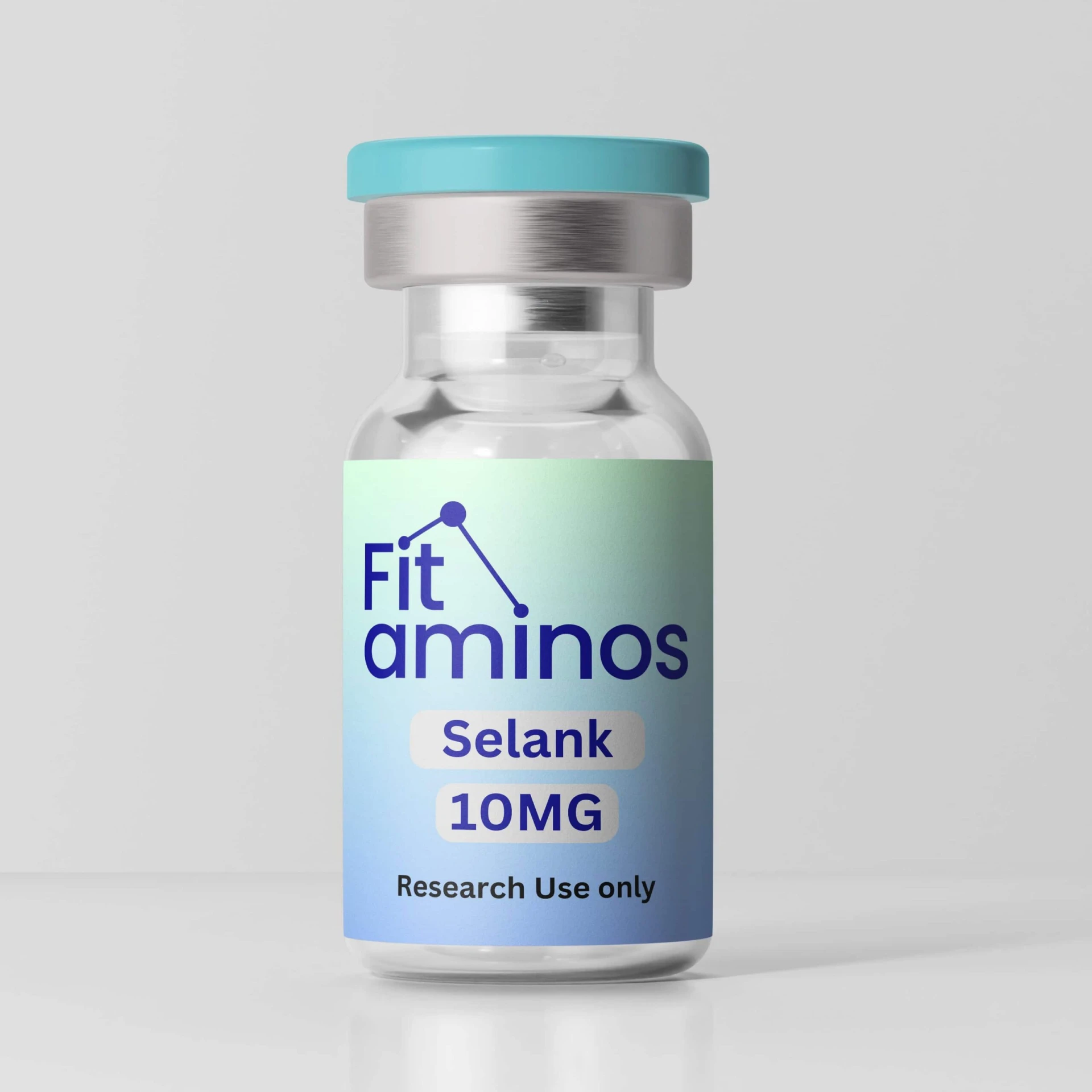
Selank is a seven residue synthetic peptide, sequence Thr-Lys-Pro-Arg-Pro-Gly-Pro. CAS 129954-34-3, molecular formula C33H57N11O9, molecular weight 751.9 g/mol. It ships as a lyophilized powder in a 10mg vial for laboratory research use only.
The current lot is SK110020 at 99.8% purity. This page covers the chemistry, what each field on the certificate measures, and where the compound stands with US regulators, which is not where a lot of buyers assume.
What is Selank?
Selank is a designed extension of a naturally occurring peptide. It takes a four residue sequence that already exists in the body and adds three more residues to the end.
The starting material is tuftsin, sequence Thr-Lys-Pro-Arg, which occurs as a fragment of an immunoglobulin heavy chain. Add Pro-Gly-Pro to its C terminus and you have Selank. Four plus three, giving seven.
Why the tail is Pro-Gly-Pro and not something else
Short peptides are fragile in solution. Peptidases take them apart quickly, and a four residue peptide like tuftsin has very little structure to slow that down.
Proline is the awkward residue in protein chemistry. Its side chain loops back and bonds to its own backbone nitrogen, which locks the local geometry and makes the bonds around it harder for an enzyme to line up and cut. A terminal run containing two prolines is therefore a cheap and effective way to protect the end of a chain.
That is what the Pro-Gly-Pro tail does. It is a stability modification, and it describes how the molecule behaves in a tube.
The same trick appears on Semax, which came out of the same institute and carries the identical Pro-Gly-Pro ending on a different four residue head. The two are frequently sold and discussed together for that reason, and structurally they are siblings rather than alternatives.
Specification
| Compound | Selank |
| Sequence | Thr-Lys-Pro-Arg-Pro-Gly-Pro (TKPRPGP) |
| Parent molecule | Tuftsin (Thr-Lys-Pro-Arg) |
| CAS number | 129954-34-3 |
| Molecular formula | C33H57N11O9 |
| Molecular weight | 751.9 g/mol |
| Residue count | 7 |
| Origin | Institute of Molecular Genetics, Russian Academy of Sciences |
| Appearance | White lyophilized powder |
| Identity method | LC-MS |
| Purity method | HPLC-UV at 214 nm |
| Vial size | 10mg |
| Storage | Keep lyophilized, cold, sealed and out of light until use |
| Classification | Research chemical. Not for human or veterinary use. |
The published lot
| Lot | Label | Purity (HPLC-UV) | Identity (LC-MS) | Net peptide | Tested |
|---|---|---|---|---|---|
| SK110020 | 10mg | 99.8% | Selank/Glycine, mass matches theoretical | 10.55 mg | Sep 25, 2025 |
Purity 99.8% against a 98.0% specification, and the observed mass matches theoretical, so the material is what the label says it is.
The identity line reads Selank/Glycine, and that is worth understanding rather than skipping. Glycine is a bulking agent used in freeze dried peptide products to give the powder physical structure in the vial. It is not an impurity, the purity figure is measured against Selank rather than against the total powder, and the certificate names it instead of leaving you to work it out. Plenty of suppliers co-formulate this way and never say so.
Net peptide content reads 10.55mg on a vial labelled 10mg. That is the measured mass of Selank. The certificate does not state whether the 10mg label refers to peptide alone or to total formulated content, so if that distinction matters for your work, ask rather than infer it.
Endotoxin was not run on this lot and the certificate says so rather than leaving the field blank.
One lot, not a run of them. Compounds that move faster carry more history, and tesamorelin has four published lots to compare against. Being straight about the sample size is part of the point of publishing at all.
What is on the certificate, field by field
“Third party tested” is a phrase, not a specification. It does not say which assays were run, against what threshold, on what date, or whether anyone outside the company can check the result.
The gap between the phrase and the practice is wide enough to drive a business through. Testing a single vial from a single batch once, years ago, satisfies the phrase perfectly well. So does testing every lot and burying the results. The phrase describes an event that may have happened rather than a policy that is running.
What closes the gap is a document with a date, a lot number, a named laboratory and a number you can hold against a specification. These are the measurements on one.
Purity by HPLC-UV at 214 nm
The sample is separated by chromatography and read at the wavelength the peptide bond itself absorbs. The target gives one peak, impurities give others, purity is the target’s share of total peak area. On a well made peptide the remainder is mostly closely related synthesis by-products rather than foreign material.
Identity by LC-MS
The molecule is weighed by mass spectrometry and the observed mass compared against the theoretical mass calculated from the intended sequence.
The distinction between this and purity is the one most worth internalising. Purity says how cleanly the sample resolves into a single dominant peak. It never asks what that peak is. Identity asks exactly that and nothing else.
On a seven residue peptide the risk is real rather than theoretical. Selank is 751.9 daltons, and swapping or omitting a single residue shifts the mass by a detectable amount while barely disturbing the chromatography. A purity assay would report such a lot as excellent. The mass would not agree with theoretical, and that is the entire point of running both.
Net peptide content
Lyophilized powder is not pure peptide by weight, and this is not a defect in the material.
Peptides are purified and isolated as salts, so the finished powder carries counter ions bound to charged residues along with residual moisture left from freeze drying. Selank has both a lysine and an arginine in its seven residues, so it carries more counter ion mass than a shorter or less charged peptide would. Weigh the vial contents and you are weighing peptide plus everything that travelled with it.
Net peptide content is measured separately for that reason and reported per vial. It is the only field that tells you the quantity of target compound you bought, and no purity figure however high can substitute for it. On lot SK110020 it reads 10.55mg, and the certificate also names glycine on the identity line, so some of the powder mass in that vial is bulking agent by design.
Endotoxin by LAL against USP <85>
Where it is run, the Limulus Amebocyte Lysate assay is performed in duplicate at a sensitivity of 0.05 endotoxin units per millilitre. Cleared means nothing was detected above that floor. It is not a claim of zero, and a certificate that reads as one is overstating the method.
The accession number
Lot SK110020 carries accession 2509240079. That number ties the certificate to Freedom Diagnostics’ own record, so the result can be confirmed with the laboratory directly instead of resting on a PDF hosted by the seller. It is the field that makes the rest of the document checkable, and hardly anyone publishes it.
Lot SK110020, published
Read the certificate, not the claim.
99.8% purity, identity confirmed by LC-MS, and 10.55mg of peptide in a 10mg vial. Accession 2509240079 ties it to the lab’s own record.
Testing policy
Every lot of every product goes to Freedom Diagnostics in Tennessee before it is sold. A batch that fails goes back to the manufacturer rather than being discounted or blended forward. The certificate is then published, including the lots that read less well, across 70 lot certificates in the library.
Where Selank stands with US regulators
This is the part most buyers get wrong, so it is worth being exact.
Selank is an approved medicine in Russia. It was developed at the Institute of Molecular Genetics there and most of the clinical work was done there.
That approval carries no weight in the United States. Selank has no FDA approval, in any formulation, for any use. A foreign approval is not a US approval and it does not make a compound legal to market here for human use.
Selank was also not among the six peptide families reviewed by the FDA’s Pharmacy Compounding Advisory Committee in July 2026. Read that as an absence of news rather than as a clearance. Compounds that were on that list include KPV, semax, BPC-157 and TB-500.
Why there is no effects section
There is a substantial published literature on this compound, much of it Russian and much of it in animals. This page does not summarise it.
An unapproved compound described by its seller in terms of what it does to a person is an unapproved drug in the FDA’s reading, and the agency put that argument to seven online peptide sellers in March 2026. The research use only wording on those sites did not help any of them.
The literature is public. PubMed indexes it, and reading it there means nobody with something to sell is choosing which studies you see.
Common questions
Is Selank the same as tuftsin?
No. Tuftsin is the four residue parent. Selank is that sequence with Pro-Gly-Pro added, giving seven residues and a different CAS number.
Selank is approved in Russia. Does that mean it is safe or legal here?
It means neither. A Russian marketing authorisation is a decision by a Russian regulator under Russian law. The FDA has not reviewed or approved Selank for any use in the United States, and material sold here as a research chemical is not a medicine regardless of its status elsewhere.
How does Selank differ from Semax?
They share the Pro-Gly-Pro tail and the same institutional origin, and they differ in the first four residues. Selank builds on tuftsin, Semax builds on a fragment of adrenocorticotropic hormone. Different starting sequences, different CAS numbers, same design idea for protecting the chain end.
Why does the certificate show no endotoxin result?
Because the assay was not run on that lot. The field reads not applicable rather than being hidden, which is the honest way to record it.
Can I check the certificate with the lab rather than trusting the site?
Yes. That is what the accession number is for, and it is printed on each certificate.
Questions about a lot
The lot number is on the vial. If you want the certificate for a particular one, or you are weighing this against another supplier’s paperwork and something does not line up, ask. Casey takes these himself.
- Email support@fitaminos.com
- Phone 949-892-9866
- Selank product page and current lot
- All research peptides
70 certificates published
One lot on file, and we say so.
Compounds that move faster carry more history. Being straight about the sample size is part of why the certificates get published at all.
Research use only. Not for human consumption. Not approved for medical, therapeutic, diagnostic, or veterinary use.