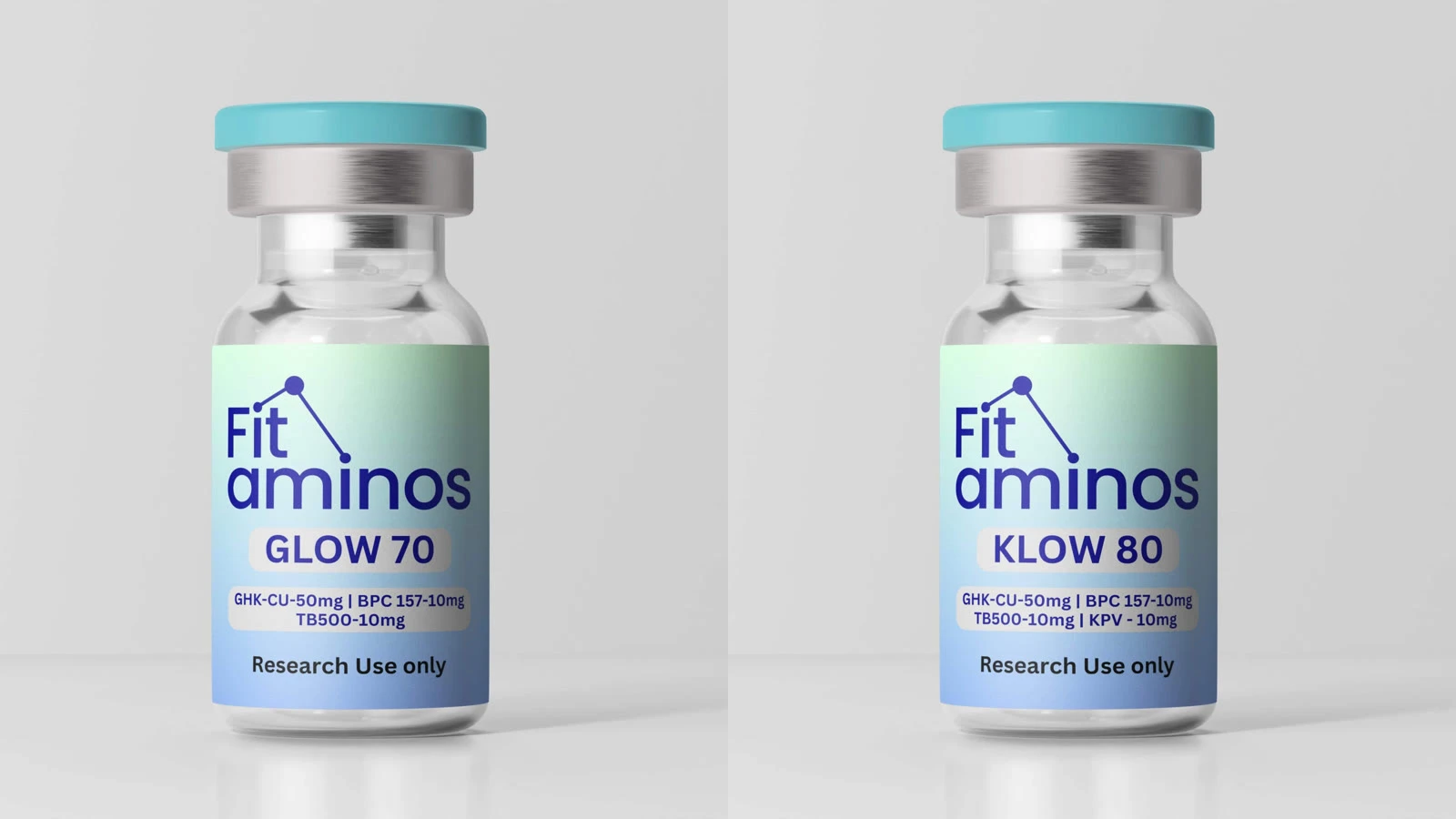
GLOW vs KLOW comes down to one extra peptide. GLOW is a three-part blend of GHK-Cu, BPC-157 and TB-500. KLOW is the same blend with KPV added as a fourth component. At Fit Aminos that means GLOW70 is a 70mg vial and KLOW 80 is an 80mg vial, and the extra 10mg is the KPV.
That’s the short answer. The useful answer is in the milligrams, because the name on a vial tells you which peptides are in it and nothing about how much of each. Below are the labeled amounts, the measured amounts from the lab, and how to check a vial against its certificate before you trust it.
What is the difference between GLOW and KLOW?
The difference between GLOW and KLOW is KPV, a three-residue peptide (lysine, proline, valine) that KLOW adds to the GLOW base. Everything else in the two blends is shared. Both carry GHK-Cu as the largest component by weight, and both carry BPC-157 and TB-500 in equal labeled amounts.
Fit Aminos sells both, the KLOW 80 blend and GLOW70, as dry lyophilized powder in sealed vials, each lot tested by Freedom Diagnostics in Tennessee, for laboratory research use only.
- GLOW70: GHK-Cu 50mg, BPC-157 10mg, TB-500 10mg, 70mg labeled total
- KLOW 80: GHK-Cu 50mg, BPC-157 10mg, TB-500 10mg, KPV 10mg, 80mg labeled total
- Shared components: GHK-Cu, BPC-157 and TB-500 in both
- The only addition: KPV, in KLOW only
Those labeled amounts are printed on our own vial labels. What the lab measured is the next section.
GLOW vs KLOW by the milligram, lot by lot
The labeled split for each blend comes from the vial label. The measured split comes from the certificate, where the lab reports net peptide content for each component separately. These are the current lots.
| Component | GLOW70 label | GLOW70 measured, lot GL7000013 | KLOW 80 label | KLOW 80 measured, lot KLO80002 |
|---|---|---|---|---|
| GHK-Cu | 50mg | 45.90mg | 50mg | 53.48mg |
| BPC-157 | 10mg | 9.38mg | 10mg | 12.03mg |
| TB-500 (Thymosin Beta-4) | 10mg | 9.40mg | 10mg | 10.44mg |
| KPV | none | none | 10mg | 11.63mg |
| Labeled total | 70mg | 80mg |
Measured values are the lab’s net peptide content per component, reported as measured. GL7000013 was reported on September 25, 2025. KLO80002 was reported on April 11, 2026.
Neither lot reads exactly on its label, and that’s normal. The GLOW70 lot reads a little under on each component, and the KLOW 80 lot reads a little over on each. The certificate doesn’t state whether a label refers to peptide alone or to total powder, so if that difference matters for your work, ask us rather than assume.
Here’s the full testing record for both blends, including the earlier KLOW 80 lot:
| Blend | Lot | Purity (HPLC-UV) | Identity (LC-MS) | Reported | Accession |
|---|---|---|---|---|---|
| KLOW 80 | KLO80002 | 99.682% | GHK-Cu, KPV, BPC-157, Thymosin Beta-4 | Apr 11, 2026 | 2604090245 |
| KLOW 80 | KL8000014 | 99.78% | See certificate | Sep 25, 2025 | 2509240095 |
| GLOW70 | GL7000013 | 99.64% | GHK-Cu, BPC-157, Thymosin Beta-4 | Sep 25, 2025 | 2509240091 |
The KL8000014 certificate reports purity for the blend and doesn’t break out a per-component split, which is why the milligram table above uses the newer lot. Two KLOW lots and one GLOW lot is a small record. We’d rather show three real certificates than imply a longer history.
What each of the four peptides is
Each component in GLOW and KLOW is a separate, well-characterized molecule, and each is also sold on its own. Here’s what the four are as chemistry, with the public PubChem record for each.
| Peptide | What it is | Formula | Molecular weight | In |
|---|---|---|---|---|
| GHK-Cu | Glycine-histidine-lysine tripeptide bound to a copper ion | C14H21CuN6O4 | 400.90 g/mol (PubChem) | GLOW, KLOW |
| BPC-157 | Synthetic 15-residue peptide | C62H98N16O22 | 1419.5 g/mol (PubChem) | GLOW, KLOW |
| TB-500 | Peptide related to thymosin beta-4, named Thymosin Beta-4 on our certificates | See certificate | See certificate | GLOW, KLOW |
| KPV | Lysine-proline-valine tripeptide, the last three residues of alpha-MSH | C16H30N4O4 | 342.43 g/mol (PubChem) | KLOW only |
The name TB-500 is used loosely across the market, sometimes for a short fragment of thymosin beta-4 and sometimes for the full protein. We go by the lab, and the lab identifies it as Thymosin Beta-4 on both blends. If you’d rather buy the two shared components as a pair, they come together in our BPC-157 and TB-500 blend.
Why GLOW and KLOW powder is blue
GLOW and KLOW powder is blue because of the copper in GHK-Cu. GHK-Cu is a copper complex and the largest component in both blends, so it colors the whole vial. Every GLOW and KLOW certificate we have lists the appearance as blue lyophilized powder. A white powder sold as GLOW or KLOW is worth a question before anything else.
Same name, different recipes
GLOW and KLOW are market names for a combination of peptides, and the amounts inside are set by whoever fills the vial. Casey Powell, who runs Fit Aminos, put it plainly when we asked: “KLOW and GLOW are industry terms for those blend of peptides.” No standard says how many milligrams of each go in.
Our own certificate library shows it. An earlier GLOW certificate, accession 2505140018 from May 2025, is a 35/10/10 blend. Our current GLOW70 is 50/10/10. Same three peptides, same name on the vial, a 15mg difference in GHK-Cu.
So when you compare GLOW from two sellers, or KLOW from two sellers, compare the numbers printed after each peptide. The total on the label, 70 or 80, is the sum of those numbers and the only part of the name that tells you anything about the split.
How to check a GLOW or KLOW vial before you trust it
Whichever side of GLOW vs KLOW you land on, checking the vial takes about two minutes with the certificate open beside it. Here’s what we’d look at, in order.
Match the lot number
The lot number on the vial should match the lot on the certificate. A certificate for a different lot is a certificate for a different vial, however good its numbers look.
Read the identity line before the purity figure
On a blend, the purity figure is the least informative number on the page. It’s one number for the whole sample, and it can’t tell you whether the split matches the label or whether a component is missing. The identity line can. LC-MS weighs each molecule against its theoretical mass, and a good blend certificate names every component it confirmed. Our KLO80002 certificate lists all four: GHK-Cu, KPV, BPC-157 and Thymosin Beta-4. A KLOW certificate that confirms three is a GLOW certificate.
Look for net content per component
Net peptide content reported for each component is the only field that shows how much of each peptide is in the vial. A blend certificate with a single purity figure and nothing per component is a partial record. Our own older KL8000014 certificate is one of those, and it’s why we point you to the newer lot for the split.
Use the accession number
The accession number ties the certificate to the lab’s own record. KLO80002 carries accession 2604090245, so the result can be confirmed with Freedom Diagnostics rather than resting on a PDF a seller hosts. Our guide to certificate fields covers the rest of what’s on the page.
Ask what happens to a batch that fails
Every batch we sell goes to Freedom Diagnostics first, and a batch that doesn’t pass goes back to the supplier. Casey’s rule on paperwork is just as simple: “Everything should have certs. If anything is missing I’ll get it fixed.” If you’re ready to compare, the current KLOW 80 and GLOW70 lots and their certificates are on each product page.
Lots KLO80002 and GL7000013
Pick the blend by what’s in the vial.
Both lots tested by Freedom Diagnostics, with every component confirmed by LC-MS. KLOW 80 is the one with KPV.
Why there’s no effects section
This GLOW vs KLOW comparison doesn’t describe what either blend does, and that’s deliberate. An unapproved compound described by its seller in terms of what it does to a person is an unapproved drug in the FDA’s reading, and the agency made that case against seven online peptide sellers in March 2026. GLOW70 and KLOW 80 are sold for laboratory research only, so this page sticks to what’s in the vial and how it was tested.
Common questions
Is KLOW the same as GLOW with KPV added?
Yes. KLOW is GHK-Cu, BPC-157 and TB-500, the same three peptides as GLOW, plus KPV. At Fit Aminos the labeled amounts of the shared three are identical in both, 50mg, 10mg and 10mg, and KLOW 80 adds 10mg of KPV.
What do the 70 and the 80 mean?
The total labeled milligrams in the vial.
Why doesn’t the measured amount match the label exactly?
Measured values are what the lab found in that lot, reported as measured, so they land a little above or below the label. On GL7000013 the GHK-Cu reads 45.90mg against a 50mg label. On KLO80002 it reads 53.48mg against 50mg. Lyophilized powder also isn’t pure peptide by weight, since peptides are isolated as salts and carry some residual moisture from freeze drying. The certificate doesn’t say whether the label figure is peptide alone or total powder. If that matters for what you’re doing, email us the lot number and we’ll tell you what we know about it rather than guess.
Is GLOW or KLOW for human use?
No. Both are sold for laboratory research only. Neither is approved for medical, therapeutic, diagnostic or veterinary use.
How should the vials be stored?
Sealed, cold and out of the light, as dry powder. Both blends ship that way.
Questions about a lot
People ask us most about how KLOW differs from GLOW and which lot is shipping. Casey takes those himself. If you’re comparing our certificate with another seller’s and something doesn’t line up, send both.
- Email support@fitaminos.com
- Phone 949-892-9866
- All peptide blends
86 certificates published
Every lot we sell has a certificate.
Each one carries the lot, the lab, the date and an accession number you can check with Freedom Diagnostics.
Research use only. Not for human consumption. Not approved for medical, therapeutic, diagnostic, or veterinary use.