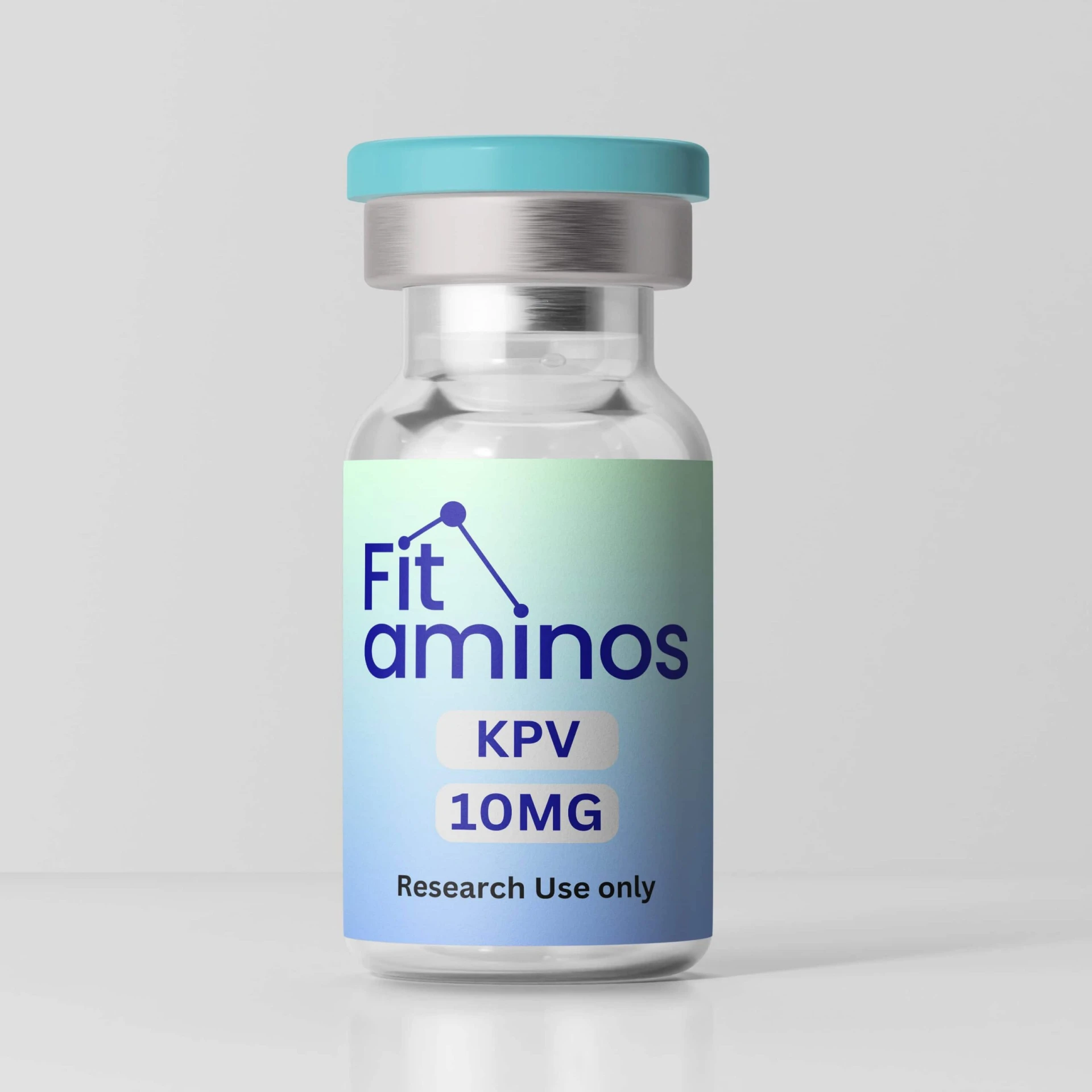
KPV is a three amino acid peptide, lysine then proline then valine, molecular weight 342.43 g/mol, CAS 67727-97-3. It ships as a lyophilized powder in a 10mg vial for laboratory research use only.
It is one of the smallest compounds in this catalog, and the certificate for the current lot shows something worth reading carefully before you order. That is covered below, along with the compound’s current standing with the FDA.
What is KPV?
KPV is not an abbreviation of a longer name. It is the one letter code for the three residues in order: K for lysine, P for proline, V for valine. Three letters, three amino acids, and that is the whole molecule.
Most peptides sold in this category run to dozens of residues. KPV has three, which makes it structurally about as simple as a peptide gets.
Where the sequence comes from
KPV is a fragment rather than an invention. Alpha melanocyte stimulating hormone is a 13 residue peptide, and KPV is the final three residues of it, positions 11 through 13.
The same three residue run appears at the corresponding position in adrenocorticotropic hormone, which is why older literature and some suppliers file the compound as ACTH (11-13). If you see that label on a certificate or a catalog listing, it is this compound and not a different one.
For a sense of scale against the rest of the shelf: at 342 daltons, KPV is roughly one fifteenth the mass of the tesamorelin in the same catalog, which runs to 44 residues and 5,136 daltons.
Specification
| Compound | KPV |
| Sequence | Lys-Pro-Val |
| Also filed as | ACTH (11-13), alpha-MSH (11-13) |
| CAS number | 67727-97-3 |
| Molecular formula | C16H30N4O4 |
| Molecular weight | 342.43 g/mol |
| Residue count | 3 |
| Appearance | White lyophilized powder |
| Identity method | LC-MS |
| Purity method | HPLC-UV at 214 nm |
| Vial size | 10mg |
| Storage | Keep lyophilized, cold, sealed and out of light until use |
| Classification | Research chemical. Not for human or veterinary use. |
The published lot, including the number most sellers would leave out
One KPV lot has a certificate online.
| Lot | Label | Purity (HPLC-UV) | Identity (LC-MS) | Net peptide | Tested |
|---|---|---|---|---|---|
| KP100023 | 10mg | 99.91% | KPV/Glycine, mass matches theoretical | 9.71 mg | Sep 25, 2025 |
Two things on that row are worth reading properly, because most buyers skip both.
The purity figure is excellent. At 99.91% against a 98.0% specification, this is one of the cleanest lots in the catalog.
The identity field says KPV/Glycine, and that is a disclosure rather than a footnote. Glycine is a standard bulking agent in freeze dried peptide products. It gives the powder physical structure so the material cakes properly in the vial instead of ending up as a film you cannot see or recover. Its presence is normal, it is not an impurity, and the purity figure is measured against the intended compound rather than against the glycine.
What matters is that the certificate names it. A supplier can co-formulate with a bulking agent and never mention it, and you would have no way to tell from a purity percentage alone.
Net peptide content reads 9.71mg on a vial labelled 10mg. Being precise about what that does and does not establish: it is the measured mass of KPV in the vial. The certificate does not state whether the 10mg label refers to peptide alone or to total formulated content including the glycine, so the two figures cannot be compared directly without knowing which. If that distinction matters for your work, ask before ordering rather than inferring it. The honest answer is that the certificate reports the measurement and leaves the label basis unstated.
Endotoxin was not run on this lot and the certificate records that rather than leaving the field blank.
Why net peptide content matters more than purity
Purity is a ratio. It tells you what proportion of the material present is the intended compound, and it tells you nothing whatsoever about how much material is there.
A vial can read 99.9% pure and hold two thirds of its labelled mass, and the purity number will look superb the whole time. Net peptide content is the absolute measurement that closes that gap.
Lyophilized peptide is never pure peptide by weight. The powder carries counter ions bound to charged residues, residual moisture from freeze drying, and on this product a glycine bulking agent as well. All of it adds mass that is not the target compound, which is why the peptide has to be weighed separately rather than inferred from the fill weight.
When comparing suppliers, ask for it by name. A seller publishing purity alone is showing you a ratio and staying quiet about the quantity. Very few publish both.
Named on the certificate
This lot is co-formulated, and we say so.
Lot KP100023 reads KPV/Glycine on the identity line. A bulking agent is normal. Not disclosing it is not.
What does the certificate actually test?
“Third party tested” is close to meaningless as a phrase, because it does not say which tests, at what threshold, or whether anyone outside the company can ever see the result.
Consider what the phrase permits. One vial, from one batch, sent to a laboratory once, and the seller can describe an entire catalog as third party tested indefinitely. It carries no commitment to test every lot, no commitment to publish what came back, and no statement of what happens when a result falls short. It is a claim about a past event, phrased to sound like a standing policy.
The questions worth asking instead are specific and every one of them has a checkable answer: which assays, measured against what specification, tested on what date, and can you read the report for the lot in your hand. These are the four measurements on a Fit Aminos certificate.
Purity, by HPLC-UV
The sample is separated by liquid chromatography and read at 214 nanometres, the wavelength the peptide bond absorbs at. The target compound gives one peak, impurities give others, and purity is the target’s share of total peak area. Most of what makes up the remainder on a well made peptide is closely related material from the synthesis rather than anything foreign.
Identity, by LC-MS
Mass spectrometry weighs the molecule and compares the observed mass against the theoretical mass calculated from the intended sequence. If the two agree, the material is what the label says.
This is the test that catches substitution, and it matters most on a compound like this one. KPV is three residues and 342 daltons. Plenty of short peptides sit near that mass, and a purity assay alone cannot tell them apart, because purity only measures how cleanly the sample separates into one dominant peak. It never asks what that peak is.
So a vial can read 99.9% pure and contain the wrong tripeptide at very high purity. Identity is the field that closes that gap, and it is the one most often missing from a supplier’s published paperwork. Pure and wrong is still wrong.
Net peptide content
The measured mass of actual peptide in the vial, reported separately from the fill weight because lyophilized powder also carries counter ions and residual moisture.
On this compound it is the field that matters most, because lot KP100023 came in under its label at 9.71mg against 10mg. That is covered in full in the section above, and it is the reason this page leads with the certificate rather than with the chemistry.
Endotoxin, by LAL against USP <85>
The Limulus Amebocyte Lysate assay detects bacterial endotoxin down to a stated sensitivity. Where it is run on a Fit Aminos lot, that sensitivity is 0.05 endotoxin units per millilitre and the assay is run in duplicate. A result of Cleared means none was found above the assay’s floor, which is not the same as zero. It was not run on lot KP100023.
Testing, and what happens to a failed batch
Every lot of every product goes to Freedom Diagnostics in Tennessee before sale. Every lot, not a sample. A batch that fails goes back to the manufacturer instead of being discounted or blended into the next run.
Each certificate carries the lab’s own accession number, 2509240085 on this lot, which ties it to Freedom Diagnostics’ internal record so the result can be confirmed with the lab directly rather than taken on our word. There are 70 lot certificates published across the catalog.
US regulatory status as of August 2026
Worth knowing before ordering, and most sellers will not raise it.
In July 2026 the FDA’s Pharmacy Compounding Advisory Committee reviewed six peptide families and recommended them for possible addition to the 503A Bulks List. KPV was one of the six, alongside BPC-157, TB-500, MOTS-c, epitalon and semax.
Three things that recommendation is not. It is not an FDA approval. It is not a ban. And it concerns pharmacy compounding rather than research supply, so it does not directly govern a product sold under a research use only framing.
What it does tell you is that the agency is actively looking at this compound right now, which is a reason to watch the category rather than assume the current position is permanent. KPV has no FDA approval in the United States, in any formulation, for any use.
Why there is no effects section
Nothing on this page describes what KPV does in a person, and nothing describes how to use the vial. That is deliberate.
An unapproved compound described by its seller in terms of what it does to a body is, in the FDA’s reading, an unapproved drug. The agency made that argument directly to seven online peptide sellers in March 2026, and the research use only wording on those sites protected none of them.
The published research is indexed on PubMed, where you can read it without a vendor selecting which studies you see.
Common questions
Is KPV the same thing as ACTH (11-13)?
Yes. Same three residues, same molecule, different naming convention.
Why does the certificate say KPV/Glycine?
Because the product is formulated with glycine as a bulking agent, which is standard practice for freeze dried peptides. It gives the powder structure in the vial. It is disclosed on the identity line rather than left for you to discover, and the purity figure is measured against KPV rather than against the total powder.
The label says 10mg and net peptide content says 9.71mg. Is the vial short?
That cannot be answered from the certificate alone, and it would be easy to assert either way. The 9.71mg is the measured mass of KPV. What the certificate does not state is whether the 10mg on the label refers to peptide alone or to total formulated content including the glycine. If the answer matters for your work, ask and get it in writing rather than inferring it from the two numbers.
Does that mean the lot failed?
No. The specification these lots are held to is a purity specification of 98.0% or better, and this lot cleared it comfortably at 99.91%. Net peptide content is reported for transparency rather than assessed against a pass or fail threshold.
Why is there only one lot listed?
Because one KPV lot has been through the lab and published so far. Compounds that move faster have more, and tesamorelin has four. The table grows as lots ship.
What does the accession number do?
It ties the certificate to the laboratory’s own internal record, so a result can be independently re-verified with Freedom Diagnostics rather than relying on a PDF the seller hosts. Almost no supplier in this category publishes it.
Checking a lot before you order
The lot number is printed on the vial. If you want the certificate for a specific one, or you are comparing what different suppliers publish and the numbers do not line up, ask. Casey answers these himself.
- Email support@fitaminos.com
- Phone 949-892-9866
- KPV product page and current lot
- All research peptides
70 certificates published
Ask for the lot you are buying.
Purity is a ratio and net peptide content is the amount. Ask any supplier for both, including this one, before the order goes in.
Research use only. Not for human consumption. Not approved for medical, therapeutic, diagnostic, or veterinary use.