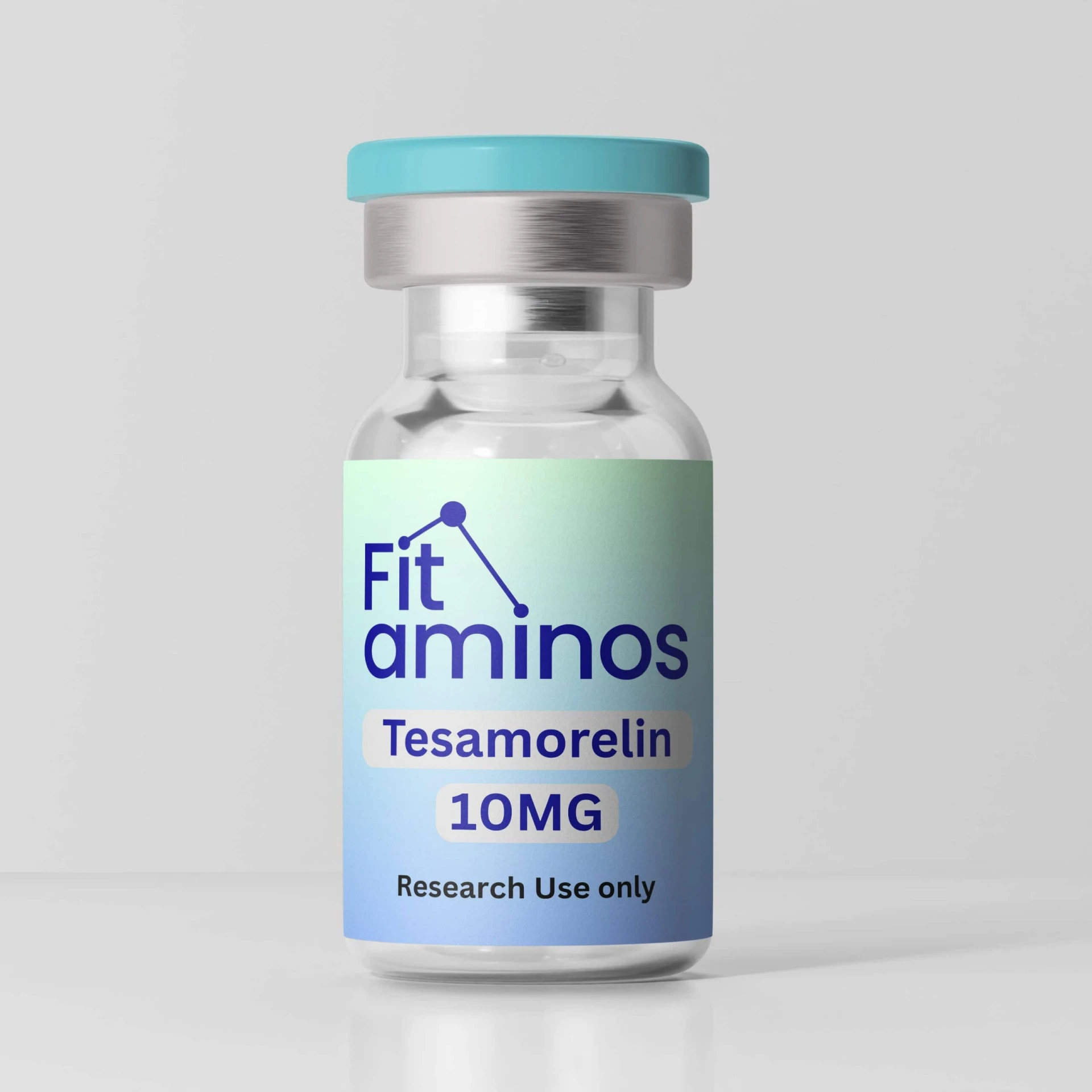
Tesamorelin is a synthetic 44 amino acid analog of human growth hormone releasing hormone, supplied here as a lyophilized powder in 10mg and 20mg vials for laboratory research use only. CAS 218949-48-5, molecular formula C221H366N72O67S, molecular weight 5,135.8 daltons.
This is a specification and documentation page. It covers what the molecule is, what every lab test on the certificate actually measures, and the published results for all four lots that carry a certificate. It does not cover what the compound does in a person, and there’s a section further down explaining why not.
What is tesamorelin?
Human growth hormone releasing hormone is a 44 residue peptide your body makes. Tesamorelin carries that same 44 residue sequence with a single modification: a trans-3-hexenoyl group attached to the N terminus.
That one change is the entire reason the molecule exists as a distinct compound. Strip it off and you are left with plain GHRH, which is a well characterised peptide but a fragile one.
The word “analog” is doing specific work here and it is worth being precise about it. An analog is not a copy and it is not a different compound that happens to behave similarly. It is the same molecular scaffold with a defined alteration, and the alteration is the product. Everything a supplier can legitimately tell you about tesamorelin comes down to three questions: is the 44 residue chain correct, is the hexenoyl group present and in the right place, and how much of the material in the vial is that molecule rather than something else. Those are the questions a certificate of analysis answers, and they are the reason this page is built around lab data rather than description.
The modification, and why it is at that exact position
Native GHRH is short lived in solution because an enzyme called dipeptidyl peptidase-IV clips it. The enzyme cuts at a specific place, the bond between the alanine at position 2 and the aspartate at position 3, and once that cut happens the fragment no longer behaves like the intact peptide.
Attaching the hexenoyl group at the N terminus puts a bulky chemical obstruction right next to that cut site. The enzyme’s active site cannot get the substrate into position, so the Ala2-Asp3 bond survives much longer than it does in the unmodified peptide.
Everything in that paragraph is a statement about a molecule and an enzyme in solution. None of it is a statement about a person, and the distinction matters more on this site than it might elsewhere.
Specification
| Compound | Tesamorelin |
| CAS number | 218949-48-5 |
| Molecular formula | C221H366N72O67S |
| Molecular weight | 5,135.8 Da |
| PubChem CID | 16137828 |
| Residue count | 44 |
| Parent sequence | Human GHRH (1-44) |
| Modification | trans-3-hexenoyl at the N terminus |
| Appearance | White lyophilized powder (recorded on every lot certificate) |
| Identity method | LC-MS, observed mass against theoretical |
| Purity method | HPLC-UV, area under curve at 214 nm |
| Vial sizes | 10mg, 20mg |
| Storage | Keep lyophilized, cold, sealed and out of light until use |
| Classification | Research chemical. Not for human or veterinary use. |
How it differs from the other GHRH analogs in this catalog
Three compounds here are built on the same parent hormone, and they are not interchangeable.
| Compound | Residues | Based on | What was changed |
|---|---|---|---|
| Tesamorelin | 44 | Full GHRH (1-44) | N terminal hexenoyl group added |
| CJC-1295 No DAC | 29 | GHRH (1-29) | Four residue substitutions, no added group |
| GHRH (1-29) itself | 29 | GHRH (1-29) | Nothing, it is the bare fragment |
So tesamorelin keeps the whole 44 residue chain and defends it with an added chemical group. CJC-1295 No DAC truncates to the first 29 residues and defends the chain by swapping four of the amino acids instead. Different strategies, different molecules, different CAS numbers, different price.
People order the wrong one of these fairly often. If you are not certain which you want, ask before you buy rather than after.
What does a certificate of analysis actually show?
Most sellers in this category say “third party tested” and stop there. That phrase on its own means very little, because it does not say which tests, to what threshold, or whether anyone outside the company can see the result.
It is worth being blunt about how little work that phrase does. A seller can send one vial from one batch to a laboratory once, receive a result, and describe every product they sell as third party tested from then on. Nothing in the phrase distinguishes that from testing every lot of every product on every order. Nothing in it commits the seller to publishing what came back, and nothing in it says what happens when a result is poor.
So the useful questions are narrower and they are all answerable: which assays were run, what threshold each was measured against, when the sample was tested, and whether the report for the specific lot in your hand is available to read. Below is what each field on these certificates measures and what it is actually worth.
Purity by HPLC-UV
The sample gets separated by high performance liquid chromatography and the detector reads absorbance at 214 nanometres, which is the wavelength the peptide bond itself absorbs at. The target compound produces a peak, impurities produce their own peaks, and purity is reported as the target’s share of the total area under all the peaks.
A figure of 99.56% means that under this method, 99.56% of the detected material was tesamorelin. The remaining fraction is usually closely related material, truncated chains and deletion sequences left over from synthesis, rather than anything foreign.
Identity by LC-MS
Purity alone cannot tell you that the pure thing is the right thing. Mass spectrometry weighs the molecule and compares the observed mass against the theoretical mass for the intended sequence. Every lot below records that the observed mass matches theoretical, which is the confirmation. The field itself reads either Confirmed or the compound name depending on the report.
This is the test that separates a genuine compound from a cheaper substitute of similar purity, and it is the one worth checking on any supplier’s certificate.
Net peptide content
A vial labelled 20mg does not contain exactly 20mg of peptide, and that is not a defect.
Peptides are purified as salts, so the finished powder carries counter ions bound to the charged residues along with a little residual moisture from the freeze drying. Both add mass. Weigh the contents of the vial and you are weighing peptide plus everything travelling with it, which is why the actual peptide mass has to be measured separately rather than inferred from the fill weight.
That measurement is what net peptide content reports, and it is the only field on the certificate that tells you the quantity rather than the quality. It gets its own section further down because on this catalog it is the number that varies most between lots.
Endotoxin by LAL, USP <85>
Limulus Amebocyte Lysate is the standard assay for bacterial endotoxin. It is run against a stated sensitivity, here 0.05 endotoxin units per millilitre, and run in duplicate. A result of Cleared means nothing was detected above that limit. It does not mean zero, it means below the assay’s floor, and a certificate that says otherwise is overstating what the test can do.
The accession number
Each certificate carries the lab’s own accession number, for example 2606120306 on lot FIT0626. That number ties the certificate to Freedom Diagnostics’ internal record, which means the result can be independently re-verified with the lab rather than taken on our word. It is the single most useful field on the page and almost nobody publishes it.
The four published tesamorelin lots
Every figure here is read off the certificate. Each lot number links to the full report and the signed PDF.
| Lot | Label | Purity | Identity | Net peptide | Vs label | Tested |
|---|---|---|---|---|---|---|
| FIT0626 | 20mg | 99.56% | Confirmed | 22.58 mg | 113% | Jun 15, 2026 |
| TM200038 | 20mg | 99.42% | Tesamorelin | 21.65 mg | 108% | Oct 30, 2025 |
| TM100037 | 10mg | 99.861% | Tesamorelin | 12.35 mg | 124% | Oct 30, 2025 |
| 2505140020 | 10mg | 99.49% | Tesamorelin | 12.52 mg | 125% | May 16, 2025 |
Across roughly thirteen months and four lots, purity held between 99.42% and 99.861% against a specification of 98.0% or better. Identity confirmed on all four. Lot FIT0626, the current shipping lot, also cleared endotoxin testing at 0.05 EU/mL sensitivity, run in duplicate.
What net peptide content tells you that purity does not
This is the column most buyers skip and it is the one that decides what you actually paid for.
Purity is a ratio. It tells you what share of the material is the target compound, and it says nothing at all about how much material is in the vial. A vial could be 99.9% pure and hold half the labelled mass, and the purity figure would look excellent.
Net peptide content is the absolute number. On these four lots it runs from 21.65mg in a 20mg vial to 12.52mg in a 10mg vial, so every one came in at or above its label, between 108% and 125%.
One caveat that applies across the catalog rather than to tesamorelin specifically: some products are formulated with a glycine bulking agent, which the certificate discloses on the identity line. KPV and Selank both are. Where that is the case the label basis is not stated on the certificate, so net peptide content and labelled size are not directly comparable. The tesamorelin certificates name the compound alone.
When you compare suppliers, ask for net peptide content and not just purity. A seller who publishes purity alone is showing you the ratio and hiding the amount.
Every lot, third party tested
Check the certificate before you order.
Four tesamorelin lots published, 99.42% to 99.861% purity against a 98.0% spec. Each carries the lab accession number, so you can verify it with Freedom Diagnostics directly.
Testing, and what happens when a batch fails
Every lot of every product goes to Freedom Diagnostics in Tennessee before it is sold. Not a sample of lots, and not the first lot of a run. Every one. It costs thousands of dollars a month and it is most of the reason the pricing here is not the lowest you will find.
A batch that fails goes back to the manufacturer. It does not get discounted, and it does not get blended into the next run.
The certificate then gets published, which is the part that matters. Testing you cannot see is a claim, and this category has no shortage of claims. There are 70 lot certificates published across the catalog, including the ones that are less flattering.
Storage and handling of the lyophilized material
Every lot certificate records the appearance as white lyophilized powder. In that state the material is comparatively stable, which is the entire reason peptides are shipped freeze dried rather than in solution.
Keep it cold, keep it sealed, and keep it out of light until you use it. Temperature cycling is worse than a single stable temperature, so repeatedly moving a vial in and out of cold storage is the thing most likely to degrade it.
Guidance on preparing or handling the material beyond storage is out of scope for this site, and that is a deliberate line rather than an oversight.
On the FDA approved product, because people ask
There is an FDA approved tesamorelin medicine. It is sold as Egrifta and it was approved in November 2010 for a specific clinical indication in a specific patient population. The FDA label database holds the full prescribing information for anyone who wants it.
What Fit Aminos sells is not that product. It is not a prescription medicine, it has not been through FDA review, and it is not approved for any use in humans or animals. Same compound name, entirely different regulatory category.
That distinction gets blurred constantly in this market, usually on purpose. It is worth stating plainly.
Why there is no effects section on this page
Most pages about this compound will tell you what it does. This one does not, and it is a deliberate choice.
A research chemical is not approved for human use. When a seller describes what such a compound does to a body, the seller is describing an unapproved drug, and that is how the FDA reads it. In March 2026 the agency sent warning letters to seven online peptide sellers on exactly that basis, and the “research use only” wording on those sites did not protect a single one of them.
So this page stays on ground that holds: what the molecule is, what the lab measured, and what the certificate says. If you want the published clinical literature, PubMed indexes it, and reading it there means reading it without a vendor choosing which studies you see.
Common questions
What purity should I expect from a tesamorelin lot?
The specification on these certificates is 98.0% or better by HPLC-UV. The four published lots came in between 99.42% and 99.861%.
Does a high purity number mean the vial is full?
No, and this is the most common misreading of a certificate. Purity is a ratio of target compound to impurities in whatever material is present. Net peptide content is the separate measurement that tells you the actual mass in the vial. Check both.
What does “Cleared” mean on the endotoxin line?
It means no bacterial endotoxin was detected above the assay’s limit of detection, which on these reports is 0.05 endotoxin units per millilitre. It is not the same as zero. Any certificate claiming a true zero is claiming more than the method can deliver.
Can I verify a certificate independently?
Yes, and that is what the accession number is for. Each certificate carries the laboratory’s own record number, so Freedom Diagnostics can confirm the result directly rather than you relying on a PDF hosted by the seller. Very few suppliers publish this field.
Is tesamorelin the same as CJC-1295?
No. Both are built on growth hormone releasing hormone, but tesamorelin is the full 44 residue sequence with an added N terminal group, and CJC-1295 No DAC is a 29 residue fragment with four amino acid substitutions. Different molecules with different CAS numbers.
Why is the lot number on my vial not in the table above?
The table covers lots with a published certificate. If yours is not listed, email the number to support@fitaminos.com and the certificate will be sent to you.
Questions about a lot or a certificate
If a figure on a COA does not look right to you, or you want to check a lot before ordering, get in touch. Casey handles these directly and would rather answer a question than have somebody guess.
- Email support@fitaminos.com
- Phone 949-892-9866
- Tesamorelin product page and current lot
- All research peptides
70 certificates published
Check a lot before you buy it.
The lot number is printed on the vial. If its certificate is not in the library, email it over and the report comes back to you.
Research use only. Not for human consumption. Not approved for medical, therapeutic, diagnostic, or veterinary use.