
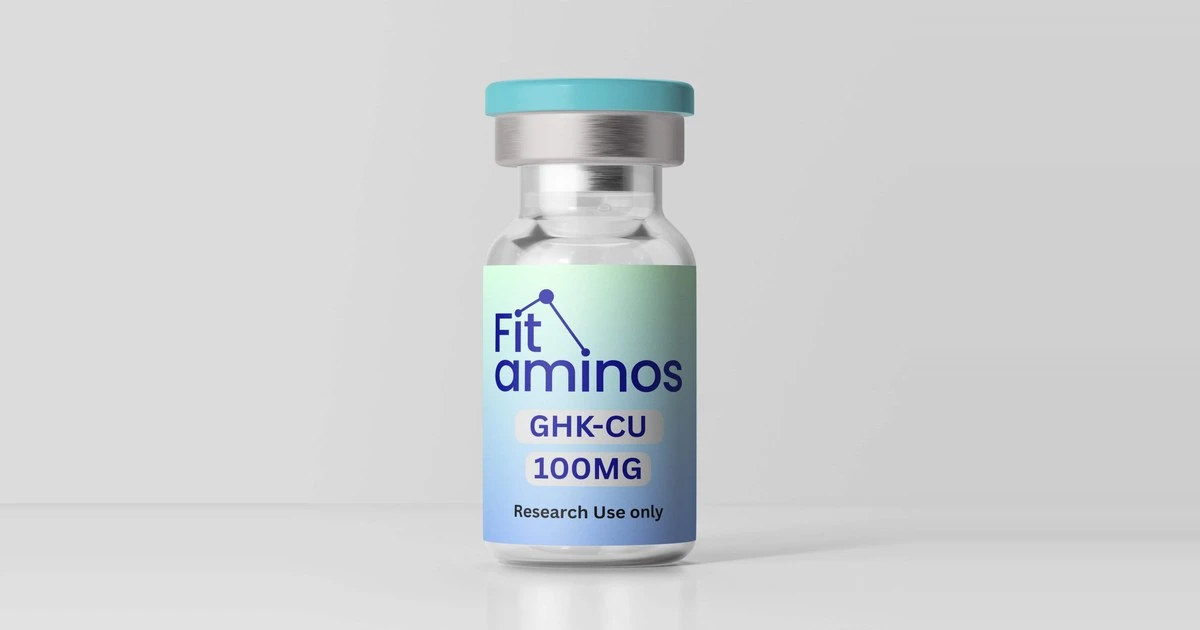
Here’s how to store peptides that arrive as a dry, freeze-dried powder in a sealed vial: freezer for the long term, refrigerator for the short term, and sealed and out of the light the whole time. A few days at room temperature won’t ruin a dry vial.
That’s how almost every peptide in our store ships. I run Fit Aminos, and this guide covers the storage line in our product specs and the lab guidance behind it. It’s about the sealed, dry vial only.
Do peptides need to be refrigerated?
Dry peptides don’t need to be refrigerated the moment they arrive, but cold storage is what keeps them stable for months. The peptide storage guidance published by the UK’s National Institute for Biological Standards and Control (NIBSC) says dry peptides are stable at room temperature for days to weeks, and that -20°C is preferred for long-term storage.
Bachem, a Swiss peptide manufacturer, says the same in its handling guide. Peptides can be shipped at room temperature, kept in a refrigerator at 4°C short term, and stored below -15°C for longer, with colder better still. For long-term storage Bachem prefers -50°C or lower, which is lab-freezer territory.
Refrigeration decides how long a peptide lasts. The trip to your door is short enough that it doesn’t.
What our product specs say
Most of our peptide vials carry the same storage line in the specs on their product page:
Store lyophilized at −20 °C, protected from light and moisture. Keep the container tightly sealed.
That line is on 28 of the 41 products in our store. Four others, including NAD and the SLU-PP-332 capsules, carry a different one: “Store sealed, cool and dry, protected from light.” If a product page doesn’t show a storage line, or you aren’t sure which applies, ask me.
How to store peptides: freezer, fridge or shelf
The right spot depends on how long you plan to keep the vial. Here’s how the guidance lines up for a sealed, dry vial:
| How long you’ll keep it | Where to keep it | Source |
|---|---|---|
| Months or longer | Freezer, -20°C or colder | Our product specs, GenScript, NIBSC (Bachem: below -15°C) |
| Short term | Refrigerator, about 4°C | Bachem, NIBSC |
| A few days, such as in transit | Room temperature, away from heat and sun | NIBSC, Bachem |
The FDA recommends keeping a home freezer at 0°F, which is about -18°C. That’s close to the -20°C in our specs, and far colder than a refrigerator. If your vial will sit for months, the freezer is the place for it.
What damages a dry peptide
Moisture, light and repeated temperature changes all wear a freeze-dried peptide down, and a cold freezer doesn’t protect against any of them on its own.
Moisture
Bachem notes that peptides tend to be hygroscopic, meaning they take up water from the air, and that absorbed water lowers the peptide content and may make it less stable. NIBSC’s guidance says moisture greatly decreases the long-term stability of solid peptides. That’s why the storage line in our specs ends with “keep the container tightly sealed.”
Light
GenScript, a peptide synthesis company, says lyophilized peptides should be stored away from bright light. Our vials ship inside an amber plastic container, and keeping the vial in that container covers it.
Temperature swings
GenScript says peptides that go through freeze-thaw cycles are susceptible to degradation. For a sealed vial, that means picking a spot and leaving it there rather than moving it in and out of the freezer.
Some peptides are more sensitive than others
Stability depends on the sequence. GenScript names two groups of amino acids that need extra care:
- Cysteine, methionine and tryptophan are prone to oxidation.
- Aspartic acid, glutamic acid, lysine, arginine and histidine tend to absorb moisture from the air.
For those moisture-prone sequences, GenScript recommends a tightly capped vial kept with a desiccant. Bachem adds that peptides containing asparagine, glutamine, methionine, cysteine or tryptophan have limited shelf lives. Here’s how those lists map onto a few peptides we carry, using their published sequences:
| Peptide | Sequence | Residues on those lists |
|---|---|---|
| MOTS-c | MRWQEMGYIFYPRKLR | Methionine, tryptophan, glutamine, glutamic acid, arginine, lysine |
| Epitalon | Ala-Glu-Asp-Gly | Glutamic acid, aspartic acid |
| GHK-Cu | Gly-His-Lys, with copper | Histidine, lysine |
| Ipamorelin | Aib-His-D-2-Nal-D-Phe-Lys-NH2 | Histidine, lysine |
| KPV | Lys-Pro-Val | Lysine |
Every peptide in that table has at least one residue on those lists. If you’re keeping one of these for a while, a sealed bag with a desiccant packet in the freezer is a cheap extra layer.
What arrives in the box
Orders ship from Mesa, Arizona, and anything placed before 4pm Arizona time goes out the same day. Each vial travels sealed inside an amber plastic container. I’ve shipped thousands of orders and had one vial break.
The certificate for each lot records what the contents should look like. 77 of our 86 certificates list a white lyophilized powder. The six that list blue are GHK-Cu and the copper blends, GLOW and KLOW.
There’s nothing you need to check when it arrives. If you’d like to compare what you received with its lab report, here’s how to read a peptide certificate of analysis, line by line. Then put the vial where its product specs say, which for most of ours is the freezer.
How long do peptides last?
Stored well, a dry peptide lasts a long time. GenScript says most lyophilized peptides are stable for several years at -20°C away from bright light, though sequences with the residues above can shorten that shelf life. A vial that has taken on moisture or sat in heat won’t get those years.
Each of our certificates shows the date its lot was tested, and every certificate we’ve published is on the certificates page.
Frequently asked questions
Can peptides be stored at room temperature?
For a few days, if they’re dry and sealed. NIBSC’s guidance says dry peptides are stable at room temperature for days to weeks. For anything longer, use the freezer.
Is the freezer or the fridge better for peptides?
The freezer, for anything you’ll keep longer than a short while. Our specs say -20°C, and a home freezer at the FDA’s recommended 0°F is about -18°C. A refrigerator at 4°C is fine short term.
What is the shelf life of a dry peptide?
GenScript puts it at several years for most lyophilized peptides kept at -20°C and away from bright light. The sequence matters, and good peptide storage, meaning sealed, dry and cold, matters most.
My peptides arrived warm. Are they still OK?
A sealed dry vial that spent a few days in transit is within what NIBSC and Bachem describe, since both say dry peptides can be kept at room temperature short term. If an order arrives damaged, email me and we’ll offer a replacement or store credit, as our shipping policy says.
Does light damage peptides?
Bright light can, which is why GenScript and our specs both say to store them away from it. Keeping the vial in its amber container, inside a closed freezer, covers it.
Questions about storing an order?
If you’re not sure how to store peptides from your order, or a package arrived in rough shape, ask me. I’m Casey, and I answer these myself. Email support@fitaminos.com or call 949-892-9866.
About the author. Casey Powell owns Fit Aminos, which ships from Mesa, Arizona. He runs the testing program himself, from sending each batch to Freedom Diagnostics to answering customer questions.
Research use only. Not for human consumption. Not approved for medical, therapeutic, diagnostic, or veterinary use.

