
Third-party tested means a lab that doesn’t belong to the seller tested a sample from that batch and put its findings on a certificate of analysis, or COA. Almost every peptide seller says it. The phrase on its own doesn’t prove much. What proves it is a certificate you can match to the lot number on your vial and look up at the lab yourself.
This guide walks through a real one, the Freedom Diagnostics certificate for our KLOW 80 lot KLO80002, line by line. Then it covers how to check that a certificate is genuine, and the red flags that should make you ask more questions before you order.
What does “third party tested” mean for peptides?
A third-party tested peptide is one where an outside lab, not the seller or the manufacturer, analyzed a sample from the production lot and reported what it found. The report is the certificate of analysis.
Three things make that report worth something:
- The lab is named and independent. You should be able to find the lab, and it shouldn’t be the seller under another name.
- The certificate is tied to a lot. A certificate covers the batch the sample came from, not the product in general. If the lot number on the certificate doesn’t match the lot on your vial, that certificate isn’t about your vial.
- You can verify it. A good lab lets anyone look up a certificate by its code, so you aren’t relying on a PDF the seller sent you.
Testing is standard in this industry. So the useful question isn’t whether a seller tests. It’s whether you can check the test.
What a peptide COA should show, using a real one
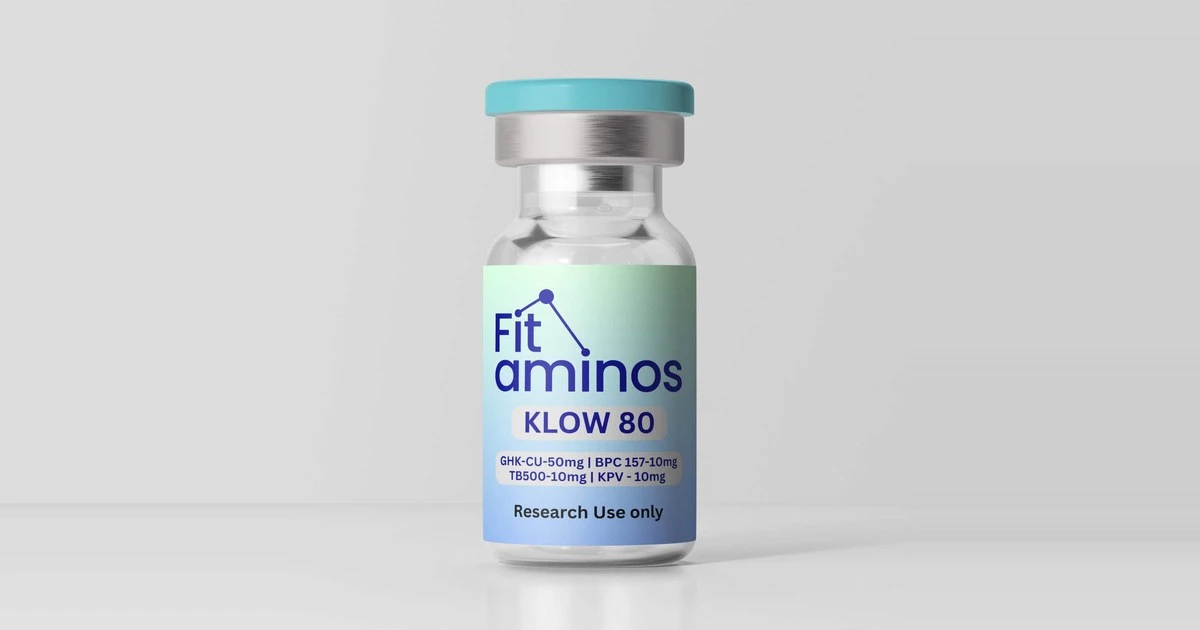
Here’s the certificate Freedom Diagnostics issued for KLOW 80, lot KLO80002. You can see the full report on its certificate page.
| Field on the certificate | What it says for lot KLO80002 | What to check |
|---|---|---|
| Lab | Freedom Diagnostics | A real, findable lab, separate from the seller |
| Client | Fit Aminos | It names the seller you’re buying from |
| Accession number | 2604090245 | The lab’s own reference for this test |
| Search code | FitA2604090245 | The code you can look up on the lab’s site |
| Received / reported | April 9, 2026 / April 11, 2026 | When the lab got the sample and when it reported |
| Product | KLOW 80mg | Matches what’s on the label |
| Lot | KLO80002 | Matches the lot printed on your vial |
| Identity | GHK-Cu / KPV / BPC-157 / Thymosin Beta-4 | Every component the label lists |
| Purity | 99.682% | A specific figure, not “high purity” |
| Net peptide content | GHK-Cu 53.48mg, KPV 11.63mg, BPC-157 12.03mg, Thymosin Beta-4 10.44mg | Measured amounts, per component |
| Appearance | Blue lyophilized powder | What the dry powder should look like |
| Method | HPLC with UV detection, coupled with mass spectrometry | How the lab measured it |
| Signed by | Alex Johnson, Principal Chemist | A named person stands behind the report |
The certificate also shows the raw data behind those numbers: a chromatogram with a peak for each of the four peptides, and a mass spectrum. You don’t need to read the graphs to use the certificate. But their being there tells you the lab ran the tests instead of filling in a template.
If a term on a certificate isn’t clear, our COA glossary defines purity, HPLC, retention time and the rest in plain language.
Purity and identity are two different tests
People often read the purity number and stop. It’s only half the answer.
Purity comes from HPLC, a method that separates everything in the sample and measures how much of it is the target material. A purity of 99.682% means that share of what the lab measured was the expected peptide content, and the remainder was something else.
Identity comes from mass spectrometry. It weighs the molecules and confirms they’re the compound the label says. A sample can show a clean, high purity figure and still be the wrong peptide. Purity tells you how clean it is. Identity tells you what it is.
A certificate that reports purity without identity leaves the more basic question unanswered. On a blend like KLOW 80, identity also confirms each component is present, which is why the KLO80002 certificate lists all four.
Why the milligrams rarely match the label exactly
The label states the amount each vial is filled to. The certificate reports what the lab measured in the sample, and the two are almost never identical.
On KLOW 80 lot KLO80002, the label lists 50mg of GHK-Cu and the lab measured 53.48mg. On GLOW70 lot GL7000013, the label lists 50mg of GHK-Cu and the lab measured 45.90mg. Both certificates are published exactly as measured.
That’s worth knowing for two reasons. A certificate where every number matches the label to the decimal is unusual, and it’s worth a second look. And when a seller publishes figures above and below the label as they came back, you’re seeing the lab’s numbers rather than marketing.
We compare the two blends’ measured amounts side by side in GLOW vs KLOW.
How to verify a peptide certificate is real
A certificate is only as good as your ability to check it. This takes about two minutes:
- Match the lot. Find the lot number on your vial or the product page and make sure the certificate shows the same one.
- Check the client name. The certificate should name the seller you bought from. A certificate issued to someone else doesn’t cover your order.
- Look it up at the lab. Freedom Diagnostics prints “Searchable via FreedomDiagnosticsTesting.com” on every certificate. On its certificate lookup page, enter the search code from the top-right table (for lot KLO80002, that’s FitA2604090245). The record on the lab’s site should match the PDF.
- Check the dates. The test date should make sense for the lot you’re getting. If a seller is still showing a certificate from years ago, ask whether the lot has changed.
- Read the method line. Look for both a purity method (HPLC) and an identity method (mass spectrometry).
If any of those don’t line up, that’s a question for the seller before you order, not after.
Red flags on a peptide COA
- No lot number, or a lot number that doesn’t match the vial
- No lab name, or a lab you can’t find anywhere
- No way to look the certificate up at the lab
- “High purity” or “99%+” instead of an exact figure
- Purity reported with no identity test
- The same certificate shown for every product, size or batch
- A client name that isn’t the seller
- No date, or a date well before the lot was made
- A blend certificate that only confirms some of the components
How Fit Aminos handles testing
Every batch goes to Freedom Diagnostics in Tennessee before we sell it. If a batch doesn’t pass, it goes back to the supplier.
We aim for 99% purity or higher. Of the 84 lot certificates on our site with a purity result, 79 tested at 99% or above, and the lowest was 98.39%, a BPC-157 lot from October 2025. Only two or three products have ever been rejected, and none of them went on sale.
We’ve also added endotoxin testing alongside purity. Newer certificates show it, and 40 of them carry an endotoxin result so far. Older lots were tested for purity and identity only.
Each lot gets its own certificate page, and every product page links to a certificate. You can browse all of them on our certificates page. Want to know which lot you’ll get before you order? Ask, and we’ll point you to its certificate.
Frequently asked questions
Is a third-party tested peptide the same as an FDA-approved one?
No. A certificate of analysis reports what a lab measured in a sample. It isn’t an approval of any kind. The peptides we sell are for laboratory research use only and aren’t approved for human use.
Does one certificate cover every vial?
It covers the lot the sample came from. Every vial from that lot shares the certificate, and a new lot gets a new test and a new certificate. That’s why matching the lot number matters more than anything else on the page.
What’s the difference between purity and net peptide content?
Purity is a percentage. It’s how much of what the lab measured was the expected material. Net peptide content is a weight in milligrams. It’s how much of each peptide the lab measured in the vial. A certificate should give you both. On lot KLO80002, purity was 99.682%, and net content was reported for each of the four peptides.
Where can I find Fit Aminos certificates?
On the certificates page, and linked from each product page. Every certificate carries a search code you can look up on the Freedom Diagnostics site.
Questions about a certificate?
If you’re looking at one of our certificates and something doesn’t make sense, or you want to know which lot is shipping right now, ask me. I’m Casey, and I answer these myself. Email support@fitaminos.com or call 949-892-9866.
About the author. Casey Powell owns Fit Aminos and runs the testing program himself, from sending each batch to Freedom Diagnostics to answering customer questions about the certificates.
Research use only. Not for human consumption. Not approved for medical, therapeutic, diagnostic, or veterinary use.

